


Article scientifique
Reprodcast – L’anœstrus de type III
L’anœstrus de type III (Kyste folliculaire et kyste folliculaire lutéinisé)
Caractéristiques
→ Persistance d’une structure de grande taille (d≥25mm)
→ Kyste folliculaire si paroi du kyste fine (<2mm, non visible à l’échographie) ou kyste folliculaire lutéinisé si paroi du kyste épaisse (2-5mm, visible à l’échographe)
→ Pas de corps jaune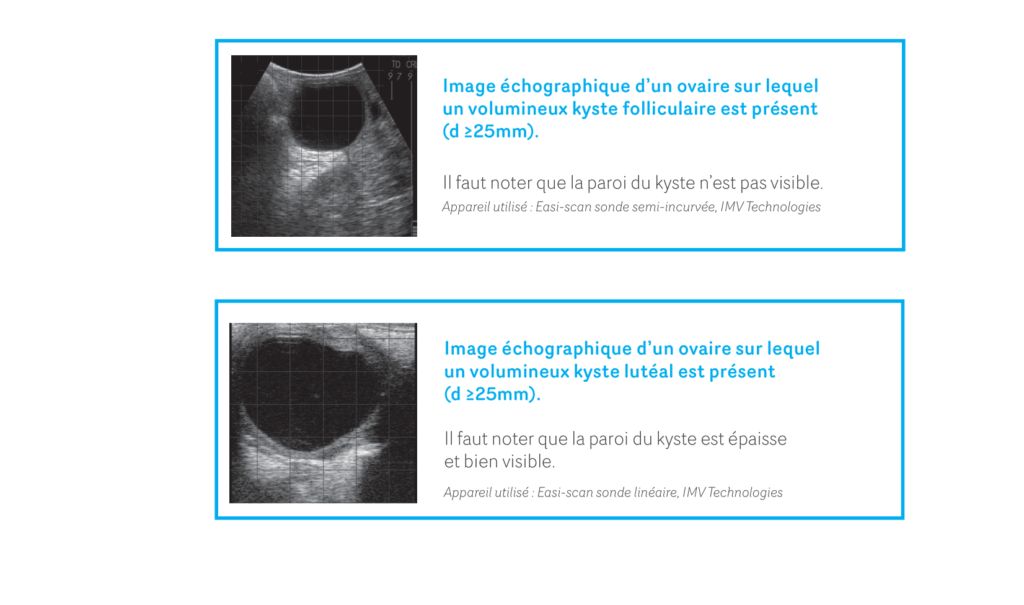
Objectif du traitement
→ Kyste folliculaire :
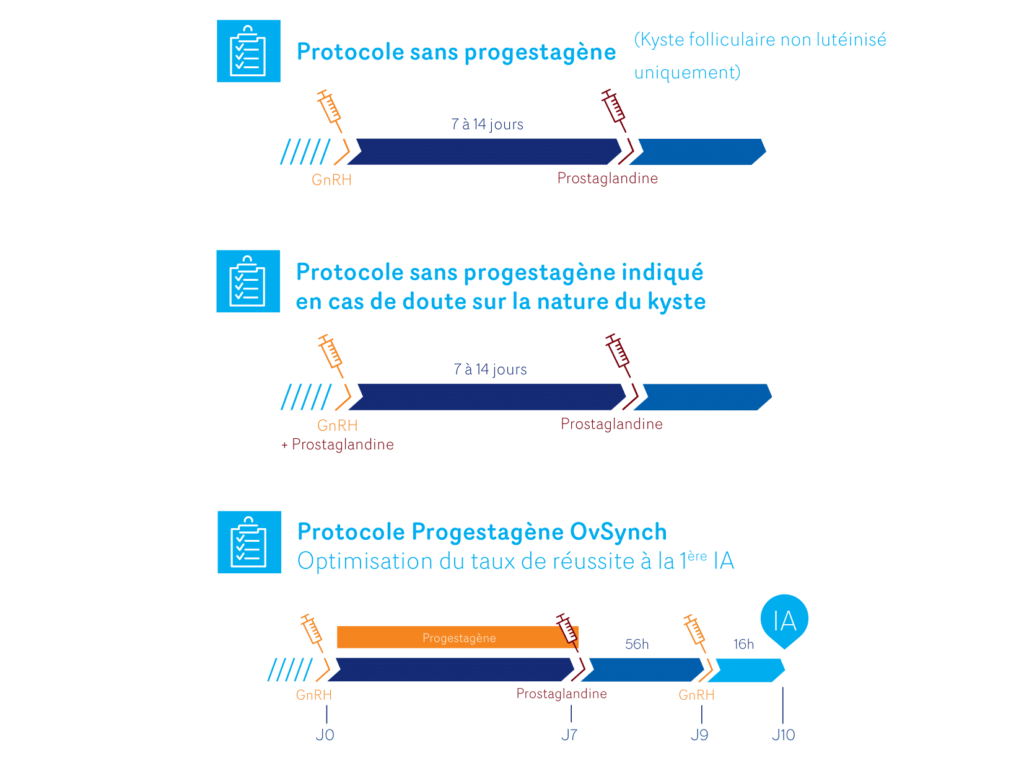
Lutéiniser le kyste folliculaire, puis provoquer la lyse du kyste lutéal induit
Ou : faire régresser le kyste tout en démarrant une nouvelle vague folliculaire
→ Kyste folliculaire lutéinisé :
Provoquer la lyse du kyste
Traitement
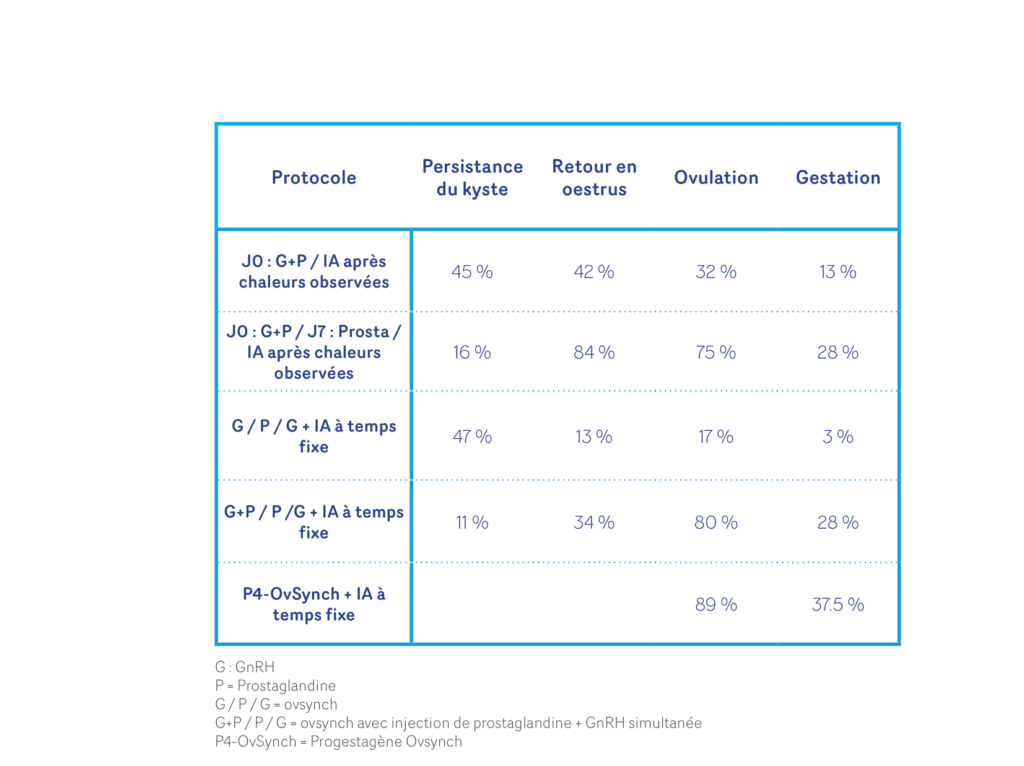
La GnRH seule donne des résultats décevants (Veronesi M.C. et al., 2003, Jou P. et al.
1999). Elle n’améliore
→ ni le délai de retour en chaleurs
→ ni le pourcentage d’oestrus observés dans les 30j
→ ni le taux de gestation
La reprise d’un état corporel suffisant est primordiale à la réussite du traitement (3,6
fois plus de chances).
BARTOLOME J. et al., Resynchronization of ovulation and timed insemination in lactating dairy cows, II: assigning protocols
according to stages of the estrous cycle, or presence of ovarian cysts or anestrus, Theriogenology, 2005, 1628-1642
BISINOTTO R. et al., Meta-analysis of progesterone supplementation during timed artificial insemination programs in dairy
cows, J. Dairy Sci., 2015, 2472-2487
CARVALHO P. et al., Development of fertility programs to achieve high 21-day pregnancy rates in high-producing dairy cows,
Theriogenology. 2018, 165-172
CRANE M. et al., Comparison of synchronization of ovulation with timed insemination and exogenous progesterone as
therapeutic strategies for ovarian cysts in lactating dairy cows, Theriogenology, 2006, 1563–1574
HOPPER R., Bovine reproduction, WILEY Blackwell, 2015, 456-467
JOU P. et al., Evaluation of theeffect of GnRH on follicular cystsin dairy cows using trans-rectalultrasonography.
Theriogenology,1999, 52, 923-937
LOPEZ-GATIUS P. et al, Reproductive performance of dairy cows with ovarian cysts after different GnRH and cloprostenol
treatment, Theriogenology, 2002, 1337-1348
SOUZA A. et al., Effects of equine chorionic gonadotropin and type of ovulatory stimulus in a timed-AI protocol on reproductive
responses in dairy cows, Theriogenology, 2009, 10-21
VERONESI M.C. et al., Recovery rate and recovery time in cows with luteal and follicular ovarian cyst after treatment with
buserelin, Vet. Sci. Commun, 2003, 27, 631-633

Visionner les épisodes ReprodCast
ReprodAction – Ceva ruminants – France
Share this publication:


